
There is plenty of confusion, and often ignorance about Wild Rice.
Wild rice is a gluten-free grass that’s slightly higher in protein than most whole grains and is a good source of fiber, folate, magnesium and a slew of other beneficial nutrients. — Great lakes wild rice
It is cultivated within the region of the Great Lakes, boasting a delightful nutty flavor that serves as an excellent alternative to rice when seeking richer taste and intricacy. A culinary tradition of the North Shore of Minnesota, Wild Rice burgers are a notable specialty.
Nevertheless, if one were to acquire a packet of wild rice from a grocery store, it is highly likely to resemble this:

Regrettably, this particular type requires an extensive cooking duration and remains tough even after hours of cooking. This is due to the formation of a black coating that develops when the rice is air-dried left around to dry after harvesting it. If, like me, you have encountered this and have declared wild rice as not very tasty, I may be able to change your opinion today.
Wood-Parched Wild Rice /aka Manoomin
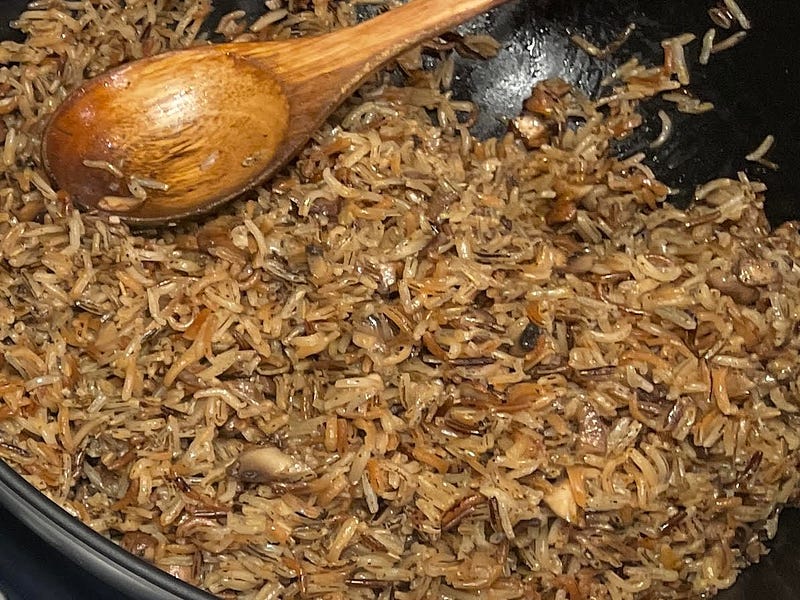
The real deal is the one that is parched over an open flame immediately following harvesting, preventing the formation of the aforementioned coating while also improving on its flavor and texture. Indigenous Wood-Parched Wild Rice is synonymous with the name Manoomin. This process imparts an uneven coloration (melding black, white, and brown hues) and a non-glossy finish, distinct from the shiny black grains depicted in the image above. This variety of wild rice cooks rapidly, and has an exquisite nutty flavor profile, and a feel-good-y chewy texture when prepared.

Where to Buy?
Certainly, the main question is about where to get it since nearby stores don’t usually have this kind. Brands like Great Lakes, KC’s etc. have online ordering facility you could use. But if you live in Minnesota and don’t want to buy a lot, like 10 pounds or more, the best thing to do is go to a Holiday gas station north of Duluth. They have wild rice there, ready to buy in smaller quantities.
My friend from Minnesota, who’s known about this for a long time, kindly told us about it. Ever since we learned this, whenever we go to Duluth or the further north, we make sure to stop at a holiday gas station to buy it. Once you’ve tried how delicious it is, you’ll probably do the same. And, it would truly make an exceptional Minnesotan souvenir to take with you wherever you go!
What to Cook?
Every time we’ve made this, we’ve pounced on it before any reasonable looking picture could be taken, and we do regret it now because we just finished our last bits of wild rice and will need to go up north soon to bring some back. We promise to update this post with pictures the next time we make it. In the mean time, here’s one very shabby picture of Mushroom and Wild-Rice Pilaf taken as we were eating. We’ve often made a vegan pilaf comprising of a slew of things including but not limited to tofu/seitan , mushrooms, scallions, corn, cranberries, sweet peas, rainbow carrots, etc. An Asian influenced wild rice pilaf has been a hit with both of us. We’ve made the following kinds:
1) with some Tobanjian paste mixed in during cooking of the vegatables/tofu along with a drizzle of toasted sesame oil at the end and
2) with some green/red curry paste, sriracha mixed in during sautéing vegetables and garnished with sweet basil at the end.
Wild rice pilaf makes for a great thanksgiving center dish along with mashed (sweet) potatoes, green bean casserole etc. We intend to make a vegan wild rice burger soon, and will post a recipe for both the pilaf and the burger when we get the chance.
Happy Manoomin Cooking!
 BabuSoge
Leave a Reply